4.1 CUDA GEMM operator performance optimization
GEMM from a naive baseline through Block-Warp-Thread three-level tiling, vectorized loads, bank-conflict removal, and double buffering — a full playbook for CUDA GEMM optimization.
Matrix multiplication (GEMM) is the central compute primitive in deep learning — from fully connected layers to attention, most work bottoms out in matrix multiply. This article starts from a naive implementation and walks through Block–Warp–Thread three-level tiling, vectorized loads, bank-conflict removal, double buffering, and more, so you get the full CUDA GEMM optimization playbook.
📑 Contents
- 1. Background and problem setup
- 2. How we analyze performance
- 3. Naive baseline
- 4. Thread-block tiling
- 5. Thread-level tiling
- 6. Warp-level tiling
- 7. Vectorized loads: float4
- 8. Removing bank conflicts
- 9. Double buffering and pipelining
- 10. Ampere async-copy pipelines
- 11. SASS-level tuning and register scheduling
- 12. Parameter selection and tuning
- Summary
- Self-check list
- References
1. Background and problem setup
1.1 What GEMM computes
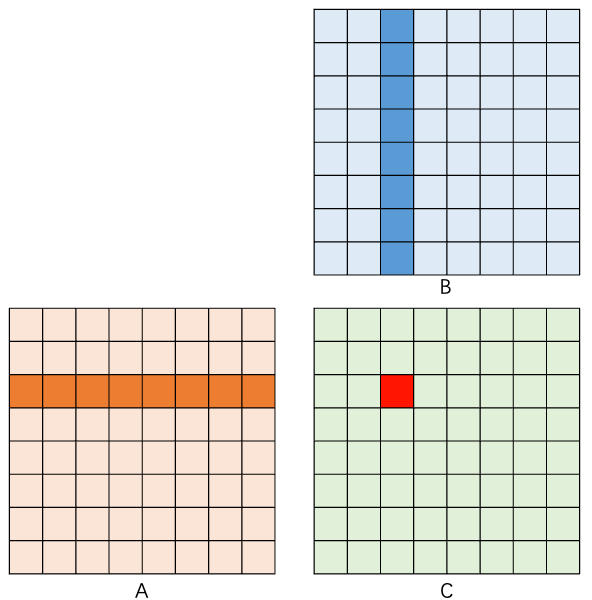
GEMM (General Matrix Multiply) computes:
where is , is , and is . Total FLOPs are (each output needs multiplies and adds).
1.2 Why GEMM matters so much
A huge share of deep-learning ops bottom out in GEMM:
- Fully connected layers: is straight matrix multiply
- Convolution: im2col turns it into GEMM
- Attention: and are both matrix multiply
- Batched GEMM: batched matmul in multi-head attention
Speeding up GEMM pays off across almost every deep-learning workload.
1.3 The metric that matters
The main metric for a GEMM kernel is effective throughput (TFLOPS):
We usually report that as a fraction of theoretical peak. On large matrices, cuBLAS often hits 90%+ of peak.
2. How we analyze performance
2.1 Roofline and arithmetic intensity
GPU performance has two hard ceilings:
- Compute ceiling: SM floating-point throughput (e.g. V100 ≈ 15.7 TFLOPS FP32)
- Bandwidth ceiling: device-memory bandwidth (e.g. V100 HBM ≈ 900 GB/s)
Whether a kernel is compute-bound or memory-bound depends on its arithmetic intensity:
When intensity exceeds the ridge point (= peak compute / peak bandwidth), the kernel is compute-limited; otherwise it is bandwidth-limited. For V100 that ridge is about FLOPs/Byte.
💡 Tip: The point of GEMM optimization is raising arithmetic intensity — reuse data so each byte feeds as much compute as possible.
2.2 Bandwidth, not latency
When you analyze a GEMM kernel, use bandwidth as the main lens, not latency. Massive thread counts hide latency through pipelining; bandwidth is a hard physical limit. An optimization works if it cuts demand on some level of the memory hierarchy.
Reference bandwidths on V100:
| 📊 Level | ⚡ Bandwidth | ⏱️ Latency |
|---|---|---|
| Registers | ~20 TB/s | 0 cycle |
| Shared memory | ~12 TB/s | 20–30 cycles |
| L2 cache | ~2 TB/s | ~200 cycles |
| HBM (global) | ~900 GB/s | 300–400 cycles |
2.3 Waves and L2
A wave is the set of thread blocks the GPU can run at once. V100 has 80 SMs and can hold 2 blocks per SM, so one wave is at most 160 blocks.
Matrix C is split into block tiles. If a wave spans and tiles in M and N, approximate L2 hit rate is:
⚠️ Note: Block scheduling order (row-major vs column-major vs zigzag) can swing L2 hit rate hard — over 10% on large matrices.
3. Naive baseline
3.1 The obvious kernel
Simplest idea: each thread computes one element of and walks the dimension as a dot product.
__global__ void sgemm_naive(const float* A, const float* B, float* C,
                            int M, int N, int K) {
    int row = blockIdx.y * blockDim.y + threadIdx.y;
    int col = blockIdx.x * blockDim.x + threadIdx.x;

    if (row < M && col < N) {
        float sum = 0.0f;
        for (int k = 0; k < K; k++) {
            sum += A[row * K + k] * B[k * N + col];
        }
        C[row * N + col] = sum;
    }
}
3.2 Performance
Arithmetic intensity is tiny. For one :
- Compute: FLOPs
- Traffic: one row of ( floats) + one column of ( floats) = bytes
Far below the ridge (~17 FLOPs/Byte), so it is badly bandwidth-bound. Measured results usually land at 6%–11% of peak.
📌 Key point: The naive kernel barely reuses data — the same row of is reread by threads on different columns, the same column of by threads on different rows, all from global memory.
4. Thread-block tiling
4.1 Core idea
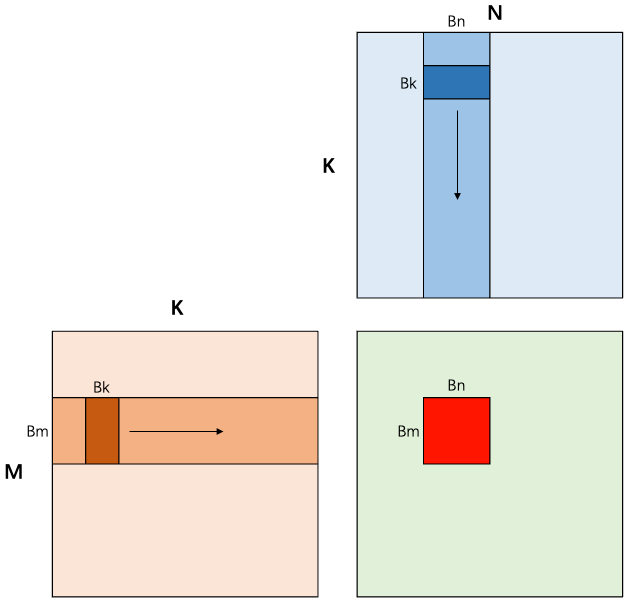
Carve into tiles; each thread block owns one. Iterate in steps of : each step, the block cooperatively moves an tile and a tile into shared memory, then does local multiply-accumulate there.
Think of a small shelf next to the workbench — instead of fetching from the distant warehouse (global memory) every time, you haul a batch to the shelf (shared memory) and workers reuse it.
4.2 Why slice along K
Given a piece of , a natural question: why not load the whole strip of and strip of and finish with one outer product? Why iterate steps along ?
Shared memory is too small. In practice is thousands to tens of thousands; plus can be tens of MB, while one SM typically has only 48–228 KB of shared memory. You must cut into -sized chunks and accumulate in batches.
Slicing along K also buys reuse: each sub-tile () and sub-tile () loaded into SMEM is shared by every thread in the block — all outputs need that pair. One Global → SMEM move serves the whole block’s compute, cutting global traffic from the naive down to roughly .
💡 Tip: Slicing along K is the golden rule of GEMM tiling. Deeper stages (thread tiling, warp tiling) keep the same idea — at every level (Global → Shared → Register), iterate along K and maximize reuse before the next move.
4.3 Higher arithmetic intensity
After tiling:
Divide numerator and denominator by : under a fixed (shared-memory budget), the AM–GM inequality says is minimized when , so intensity is highest when and are close.
With : intensity = FLOPs/Byte, well above the ridge.
4.4 Cooperative load layout
One important detail: when loading tileA and tileB, thread layout must keep coalesced global access — adjacent threads in a warp touch consecutive addresses.
Example with :
- Load tileA (): each row has only 8 elements, so 8 adjacent threads own a row. Reshape 256 threads as (32 rows × 8 cols); each round loads 32 rows, 4 rounds cover 128.
- Load tileB (): each row has 128 elements, so 32 adjacent threads own a contiguous segment. Reshape as (8 rows × 32 cols); each round covers all 8 rows, 4 rounds cover 128 columns.
Index math for the reshape:
int tid = threadIdx.x;

// Thread coords when loading tileA (8 cols × 32 rows)
int a_thread_x = tid % 8;       // column
int a_thread_y = tid / 8;       // row

// Thread coords when loading tileB (32 cols × 8 rows)
int b_thread_x = tid % 32;      // column
int b_thread_y = tid / 32;      // row
💡 Tip: With this layout, one warp (32 consecutive tids) covers 32 consecutive floats in a tileB row — perfect coalescing. For tileA, the warp covers 4 consecutive rows × 8 cols; the 8 elements in each row are still contiguous.
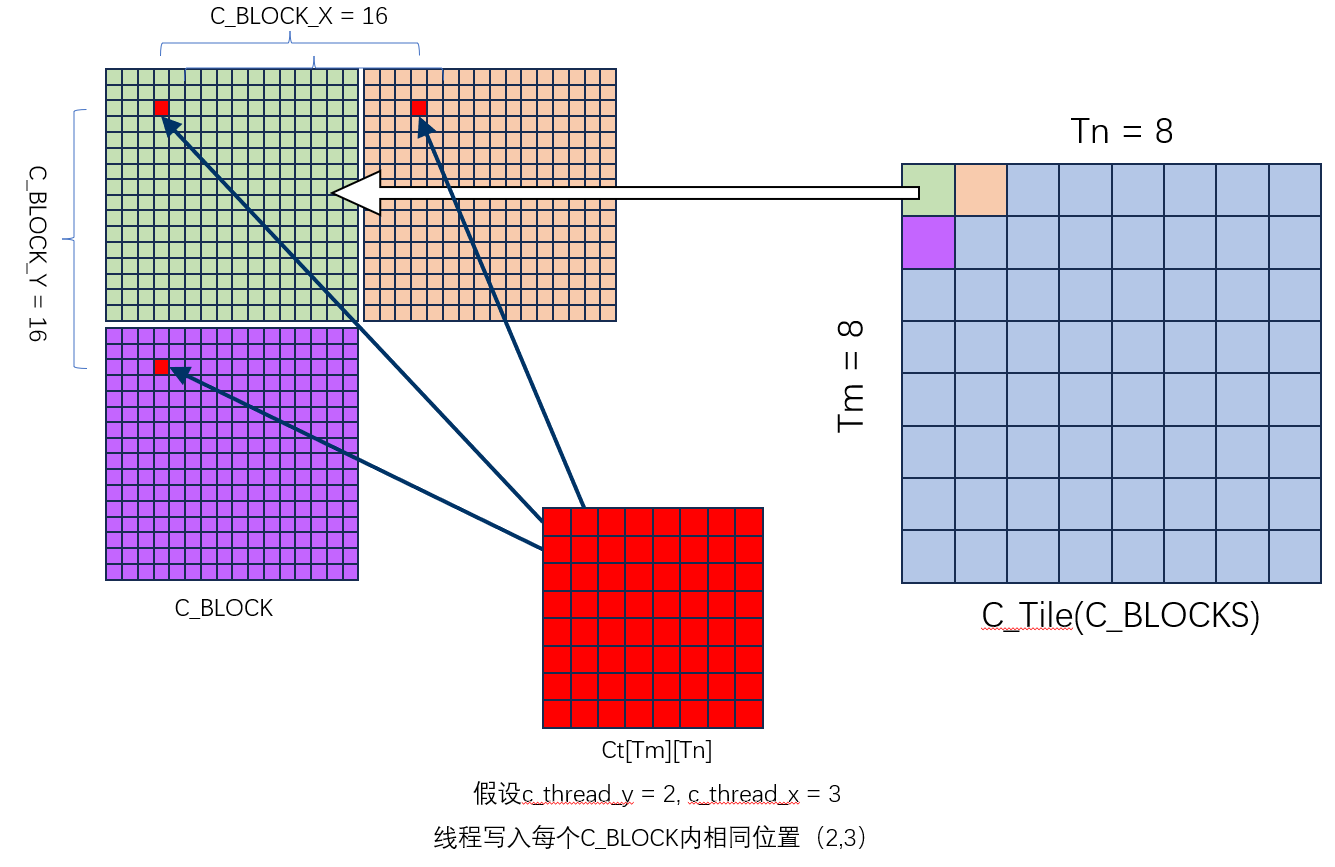
- Output tileC (): split tileC into
C_BLOCK_YC_BLOCK_X=BLOCK_SIZE()C_BLOCKs. HereC_BLOCK_X = C_BLOCK_Y = 16, so there areTn = BN / C_BLOCK_XC_BLOCKs in X andTm = BM / C_BLOCK_Yin Y. Each thread writes one value at the same relative position in everyC_BLOCK, forTmTnvalues total
// Thread layout when computing tileC (16×16)
constexpr int C_BLOCK_X = 16;
constexpr int C_BLOCK_Y = BLOCK_SIZE / C_BLOCK_X;  // = 16
int c_thread_x = tid % C_BLOCK_X;
int c_thread_y = tid / C_BLOCK_X;

// Each thread owns Tm×Tn output elements
constexpr int Tm = BM / C_BLOCK_Y;  // = 8
constexpr int Tn = BN / C_BLOCK_X;  // = 8
float Ct[Tm][Tn] = {0.0f};
⚠️ Note: The 8×8 outputs per thread are not contiguous — they are strided by C_BLOCK_Y=16 rows and C_BLOCK_X=16 cols. 256 threads form a grid; each thread “jumps” 8 times in M and N to cover the tileC.
4.5 Implementation
template <int BM, int BN, int BK, int BLOCK_SIZE>
__global__ void sgemm_block_tiling(float* A, float* B, float* C,
                                   int M, int K, int N) {
    __shared__ float As[BM][BK];
    __shared__ float Bs[BK][BN];

    int r0 = blockIdx.y * BM;
    int c0 = blockIdx.x * BN;
    int tid = threadIdx.x;

    // Thread reshape for loading tileA
    constexpr int A_BLOCK_X = BK;  // = 8
    constexpr int A_BLOCK_Y = BLOCK_SIZE / A_BLOCK_X;  // = 32
    int a_thread_x = tid % A_BLOCK_X;
    int a_thread_y = tid / A_BLOCK_X;

    // Thread reshape for loading tileB
    constexpr int B_BLOCK_X = 32;
    constexpr int B_BLOCK_Y = BLOCK_SIZE / B_BLOCK_X;  // = 8
    int b_thread_x = tid % B_BLOCK_X;
    int b_thread_y = tid / B_BLOCK_X;

    // Thread layout for computing tileC (16×16)
    constexpr int C_BLOCK_X = 16;
    constexpr int C_BLOCK_Y = BLOCK_SIZE / C_BLOCK_X;  // = 16
    int c_thread_x = tid % C_BLOCK_X;
    int c_thread_y = tid / C_BLOCK_X;

    // Each thread owns Tm×Tn outputs
    constexpr int Tm = BM / C_BLOCK_Y;  // = 8
    constexpr int Tn = BN / C_BLOCK_X;  // = 8
    float Ct[Tm][Tn] = {0.0f};

    // K-Loop
    for (int k = 0; k < K; k += BK) {
        // Cooperative load of tileA (strided loop over BM rows)
        #pragma unroll
        for (int i = a_thread_y; i < BM; i += A_BLOCK_Y) {
            int r = r0 + i, c = k + a_thread_x;
            As[i][a_thread_x] = (r < M && c < K) ? A[r * K + c] : 0.0f;
        }

        // Cooperative load of tileB (strided loop over BN cols)
        #pragma unroll
        for (int j = b_thread_x; j < BN; j += B_BLOCK_X) {
            int r = k + b_thread_y, c = c0 + j;
            Bs[b_thread_y][j] = (r < K && c < N) ? B[r * N + c] : 0.0f;
        }

        __syncthreads();

        // Outer-product accumulate As × Bs
        #pragma unroll
        for (int p = 0; p < BK; p++) {
            for (int i = 0; i < Tm; i++) {
                int row = c_thread_y + i * C_BLOCK_Y;
                for (int j = 0; j < Tn; j++) {
                    int col = c_thread_x + j * C_BLOCK_X;
                    Ct[i][j] += As[row][p] * Bs[p][col];
                }
            }
        }

        __syncthreads();
    }

    // Write results back
    for (int i = 0; i < Tm; i++) {
        int r = r0 + c_thread_y + i * C_BLOCK_Y;
        for (int j = 0; j < Tn; j++) {
            int c = c0 + c_thread_x + j * C_BLOCK_X;
            if (r < M && c < N) C[r * N + c] = Ct[i][j];
        }
    }
}
4.6 Parameter choices
| 📊 Param | 📝 Suggested | 💡 Why |
|---|---|---|
| BM, BN | 128 | Intensity 32, enough to saturate compute |
| BK | 8 | Shared-memory use stays modest (128×8×4=4KB per matrix) |
| Block size | 16×16=256 | Matches BM/BN split; allows 2 blocks/SM |
⚠️ Note: Both __syncthreads() calls are required — the first so loads finish before compute, the second so compute finishes before shared memory is overwritten.
5. Thread-level tiling: register reuse
By now the optimization story is a clear three-level move chain:
graph LR
    A["Global Memory"] -->|"Block cooperative load BM×BK / BK×BN"| B["Shared Memory"]
    B -->|"Thread loads TM+TN floats"| C["Register"]
    C -->|"TM×TN FMAs"| D["Results"]
Every level follows the same rule: iterate along K, move a small chunk, maximize reuse at the current level, then move the next chunk. Focus now is Shared Memory → Register.
5.1 Problem: shared memory is still the bottleneck
The previous kernel (Section 4.5) already gives each thread (8×8) outputs, but As[row][p] and Bs[p][col] sit inside the triple loop — the compiler may hoist some loads, yet structurally every FMA still depends on an implicit shared-memory read. When 256 threads hammer shared memory, you get MIO Throttle Stall.
Fix: explicitly separate “read from shared memory” and “do FMA” — batch-load into register arrays (a_frag, b_frag), then outer-product in registers. Each p-Loop step then needs only shared reads for FMAs.
5.2 Outer-product decomposition
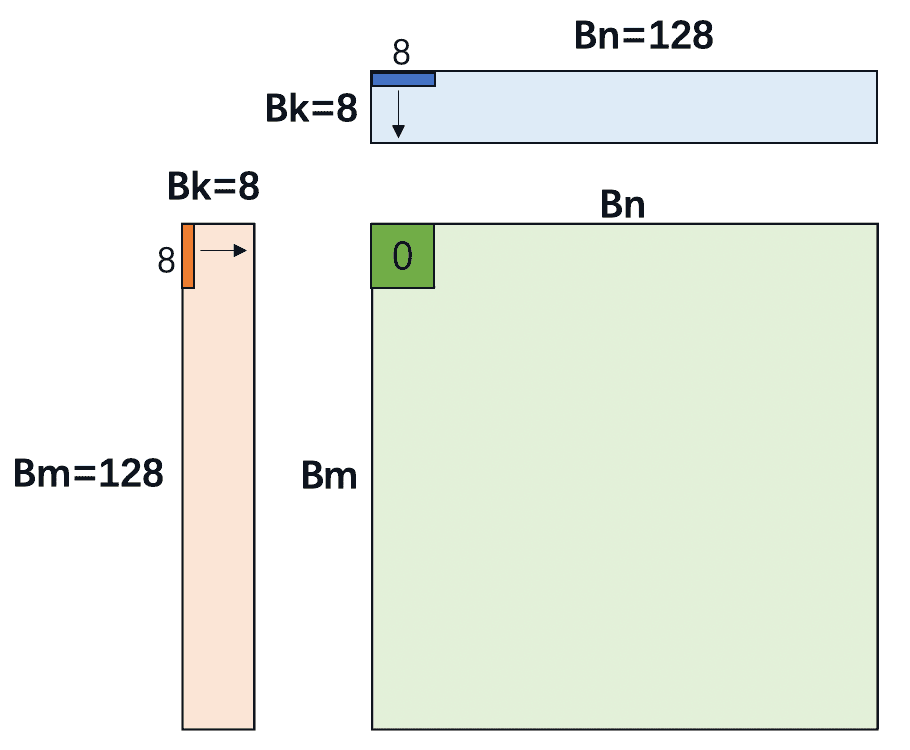
Loop order is the key. Classic inner-product (K innermost) cannot reuse and elements:
// Inner product: each thread accumulates one C element -> low reuse
for k: sum += A[row][k] * B[k][col]
Switch to outer product (K outermost):
// Outer product: each thread owns TM×TN C elements
for k:
    load A_frag[TM] from smem  // read TM A elements once
    load B_frag[TN] from smem  // read TN B elements once
    for i in TM:
        for j in TN:
            C_frag[i][j] += A_frag[i] * B_frag[j]  // TM×TN FMAs
Compute-to-traffic analysis: each K step reads floats from shared memory ( bytes) and does FMAs ( FLOPs):
Same form as Section 4.3 — not a coincidence: outer product is block tiling pushed down to the register level. AM–GM again: with (register pressure proxy) fixed, intensity peaks at .
Why :
- Registers per thread: . At that is floats.
- Plus indexes and temps, ~90–120 registers/thread — about half the 255 per-thread cap, so you can still keep occupancy (at least 2 blocks/SM).
- At , alone wants 256 registers → spill to local memory and performance falls.
Versus inner product: inner product needs one shared-memory float from and one from per FMA, ratio by bytes or by elements. Outer product at is by elements — 4× better — compute that used to need 4 shared accesses now needs 1.
5.3 Implementation
template <int BM, int BN, int BK, int TM, int TN>
__global__ void sgemm_thread_tiling(const float* A, const float* B, float* C,
                                    int M, int N, int K) {
    __shared__ float As[BM][BK];
    __shared__ float Bs[BK][BN];

    // Each thread owns a TM×TN sub-block of C
    const int thread_num = BM / TM * BN / TN;  // = 256
    int tid = threadIdx.x;
    int thread_row = (tid / (BN / TN)) * TM;
    int thread_col = (tid % (BN / TN)) * TN;

    // Register storage
    float a_frag[TM];
    float b_frag[TN];
    float c_frag[TM][TN] = {0.0f};

    int by = blockIdx.y, bx = blockIdx.x;

    for (int bk = 0; bk < K; bk += BK) {
        // Cooperative load A, B into shared memory (bounds checks omitted)
        load_tile_A(A, As, by, bk, tid, M, K);
        load_tile_B(B, Bs, bx, bk, tid, K, N);
        __syncthreads();

        // Outer-product accumulate
        for (int k = 0; k < BK; k++) {
            // Shared memory -> registers
            for (int i = 0; i < TM; i++)
                a_frag[i] = As[thread_row + i][k];
            for (int j = 0; j < TN; j++)
                b_frag[j] = Bs[k][thread_col + j];

            // Outer product in registers
            for (int i = 0; i < TM; i++)
                for (int j = 0; j < TN; j++)
                    c_frag[i][j] += a_frag[i] * b_frag[j];
        }
        __syncthreads();
    }

    // Write back to global memory
    for (int i = 0; i < TM; i++)
        for (int j = 0; j < TN; j++)
            C[(by * BM + thread_row + i) * N + bx * BN + thread_col + j] = c_frag[i][j];
}
5.4 Register budget
With :
c_frag: registersa_frag+b_frag: registers- Indexes and temps: ~30 registers
- Total: about 110–128 registers/thread
V100 has 65536 registers per SM. 128 regs/thread × 256 threads/block = 32768 regs/block, so 2 blocks/SM (512 threads = 16 warps), occupancy = 25%.
💡 Tip: 25% occupancy looks low, but GEMM has huge ILP — each thread has 64 independent FMA chains, enough to hide pipeline latency.
6. Warp-level tiling
6.1 Motivation
On top of thread tiling, ask: how should a warp’s 32 threads access shared memory?
If threads are laid out (one row of 32), reading broadcasts one element to all 32, but reading needs 32 different elements. flips the preference.
6.2 Warp-tile shape and intensity
Suppose a warp has threads in M and in N (), each owning . In one p-Loop step (one step along K):
- With shared-memory broadcast, the warp really reads distinct tileA elements (the threads at the same M position share the same values)
- And distinct tileB elements (the threads at the same N position share the same values)
- Each thread does FMAs; the warp does FLOPs
Warp-level compute-to-traffic ratio (set , so the denominator ):
The ratio scales with . Under , minimize . AM–GM: . Among integers, and () are best.
6.3 Per-thread coordinates inside a warp
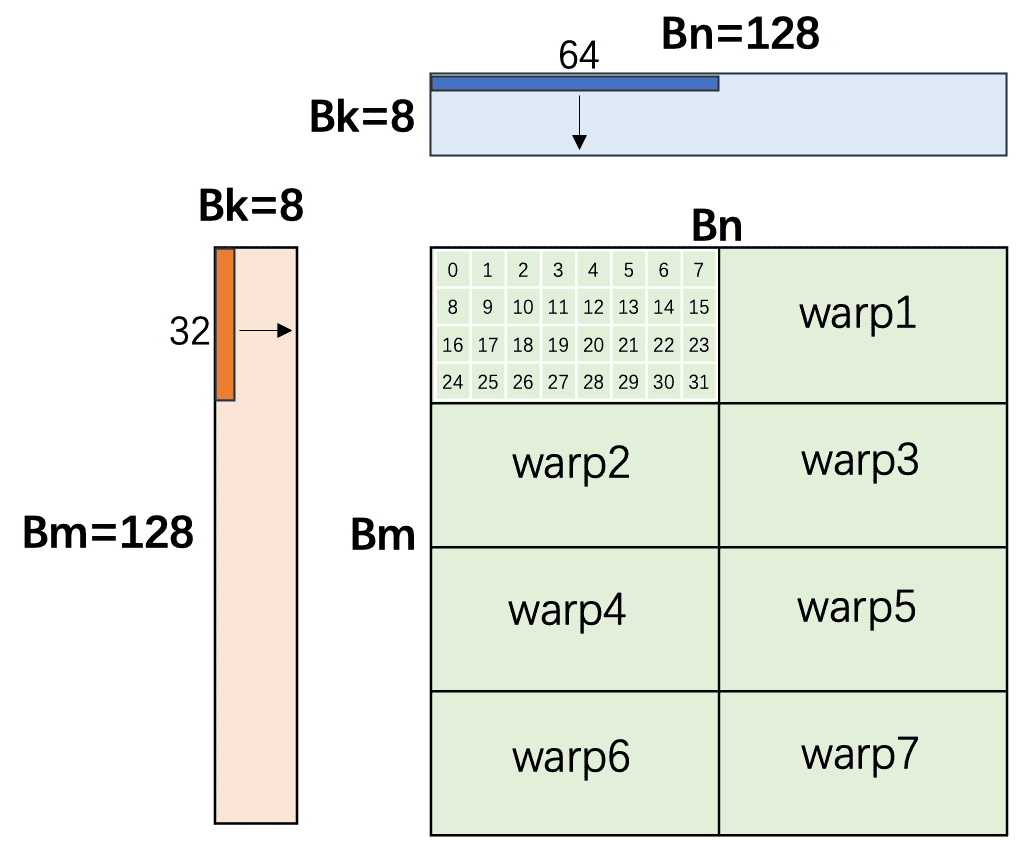
With , a block has 256 / 32 = 8 warps.
Take a warp layout and : each warp computes a C sub-block.
With that layout, compute each thread’s starting coords in the block tile. Let tid be the global thread id in the block:
int warp_id = tid >> 5;            // tid / 32
int lane_id = tid & 31;           // tid % 32

// Warp position in the block (4×2)
int warp_row = warp_id >> 1;      // M: 0~3
int warp_col = warp_id & 1;       // N: 0~1

// Lane position inside the warp (4×8, row-major)
int lane_row = lane_id >> 3;      // M: 0~3
int lane_col = lane_id & 7;       // N: 0~7

// Start row/col of this thread's TM×TN sub-block in the block tile
int row_c = (warp_row * 4 + lane_row) * TM;  // = (warp_row*4 + lane_row) * 8
int col_c = (warp_col * 8 + lane_col) * TN;  // = (warp_col*8 + lane_col) * 8
Example tid = 18: warp_id = 0, lane_id = 18, warp_row = 0, warp_col = 0, lane_row = 18 >> 3 = 2, lane_col = 18 & 7 = 2. Start coords row_c = 16, col_c = 16 — the thread owns the sub-block at rows 16~23, cols 16~23 of the block tile.
7. Vectorized loads: float4
7.1 Why vectorize
Moving global → shared one float (32 bit) at a time burns many LDG/STS instructions. The memory system can move 128 bit per transfer (float4), cutting instruction count to 1/4 and easing issue pressure.
7.2 float4 load macro
#define FLOAT4(ptr) (reinterpret_cast<float4*>(&(ptr))[0])
Usage:
// Load 4 consecutive floats at once
float4 tmp = FLOAT4(A[row * K + col]);
7.3 Transposed A in shared memory
Problem: is row-major in global memory. After the load, the inner loop reads by column (different threads on the same row of As read the same column), so float4 does not apply.
Fix: store transposed in shared memory — As[BK][BM] instead of As[BM][BK]. Column access becomes row access, and you can float4-load 4 consecutive elements.
// Load one contiguous row of A from global, store transposed into shared
float4 a_val = FLOAT4(A[global_row * K + bk + load_col]);
As[load_col + 0][local_row] = a_val.x;
As[load_col + 1][local_row] = a_val.y;
As[load_col + 2][local_row] = a_val.z;
As[load_col + 3][local_row] = a_val.w;

// Shared reads can use float4 (contiguous addresses)
float4 a_frag_vec = FLOAT4(As[k][thread_row]);
7.4 Coordinate mapping after float4
With float4, the 8 elements a thread owns are no longer 8 positions spaced by C_BLOCK_Y rows — they become two groups of 4 contiguous elements (float4 reads 4 consecutive floats). That changes how Ct maps back onto .
Without float4: row of Ct lands at C_THREAD_Y + i * C_BLOCK_Y in tileC.
With float4: Ct’s 8 rows split into two contiguous groups of 4; coordinates become:
tileC_row = 4 * C_THREAD_Y + (i / 4) * 4 * C_BLOCK_Y + (i % 4)
tileC_col = 4 * C_THREAD_X + (j / 4) * 4 * C_BLOCK_X + (j % 4)
Write-back changes accordingly:
for (int i = 0; i < Tm; i++) {
    int r = r0 + 4 * C_THREAD_Y + (i / 4) * 4 * C_BLOCK_Y + (i % 4);
    for (int j = 0; j < Tn; j++) {
        int c = c0 + 4 * C_THREAD_X + (j / 4) * 4 * C_BLOCK_X + (j % 4);
        if (r < M && c < N) C[r * N + c] = Ct[i][j];
    }
}
7.5 Gains
Vectorized loads typically:
- Cut load/store instruction count by 75%
- Ease MIO throttle stalls
- Raise effective Global → Shared bandwidth
- Deliver about 15%–30% measured speedup
8. Removing bank conflicts
8.1 What a bank conflict is
Shared memory is split into 32 banks, each 4 bytes wide. Byte maps to bank .
Why 32 banks? Not an accident — 32 matches warp width. The hardware goal: in the ideal case each of 32 threads hits a different bank and finishes in one cycle at peak bandwidth. Picture each bank as a single-lane road: one 4-byte access per cycle. 32 lanes serve one warp.
When several threads in the same warp hit different addresses in the same bank at once, those accesses serialize into an N-way bank conflict — many cars in one lane, throughput .
If they hit the same address in the same bank, hardware broadcasts: one read, result delivered to all requesters, no conflict.
⚠️ Note: Bank conflict is defined inside a warp. Different warps hitting the same bank do not conflict — they are already time-multiplexed.
Typical LDS.32 (1 float per thread) cases:
| 📊 Case | ✅ Conflict? | 📝 Why |
|---|---|---|
| 32 threads, 32 different banks | None | Ideal, 1 transaction |
| Threads 0–31 hit different banks across layers | None | Banks differ; layer does not matter |
| Many threads, same bank, same address | None | Broadcast |
| 2 threads, same bank, different addresses | 2-way | Needs 2 serialized transactions |
8.2 Memory transactions under float4
Bank conflict under float4 needs the transaction split story first:
- float (32 bit/thread): warp touches 128 bytes → one memory transaction
- float2 (64 bit/thread): warp touches 256 bytes → 2 transactions, 16 threads each (half-warp)
- float4 (128 bit/thread): warp touches 512 bytes → 4 transactions, 8 threads each (quarter-warp)
Bank conflict is judged inside one transaction, so with float4 you only care about conflicts among the 8 quarter-warp threads.
Broadcast trigger conditions (float4):
Either of these can merge two quarter-warps into one transaction:
- Condition A: lane and lane () touch the same address (or one is inactive)
- Condition B: lane and lane () touch the same address (or one is inactive)
8.3 How warp shape drives bank conflicts
Warp shape (thread layout in M×N) decides whether shared reads conflict. Take as the bad example.
reading tileB:
tileB is . Row-major storage fills one bank layer every 32 floats. Each thread needs consecutive floats (two LDS.128 float4 reads).
In the first quarter-warp (lanes 0–7):
- Lane 0 reads banks 0~3 layer 0 (B elements 0~3)
- Lane 4 reads banks 0~3 layer 1 (B elements 32~35, offset elements = 1 bank layer)
Lanes 0 and 4 hit different addresses in the same banks → 2-way bank conflict. One quarter-warp that should be 1 transaction becomes 2.
reading tileA:
Without transpose, As[BM][BK] = : 8 elements per row, 4 rows fill one bank layer (). Threads read values along M, spaced by floats (cross-row), not contiguous, so only LDS.32 one-by-one. Conflict is judged across the whole warp.
Lane 0 (M row 0) reads As[row][k]; lane 16 (M row 1) reads As[row+8][k]. Row spacing of 8 floats means 8 rows span 2 bank layers ( elements = 2 layers) → same bank, different layer → 2-way conflict.
📌 Key point: conflicts on both A and B — among the worst layouts. The direct fix for A is transposed storage (As[BK][BM]), so M-direction reads become contiguous, LDS.128 applies, and quarter-warp broadcast can fire.
plus transposed A avoids conflicts on both sides.
8.4 Transaction analysis for warp(4×8) with float4
Warp shape , float4 access: conflict judged inside a quarter-warp (8 threads). The quarter-warp fills N, shape . Analyze both tiles.
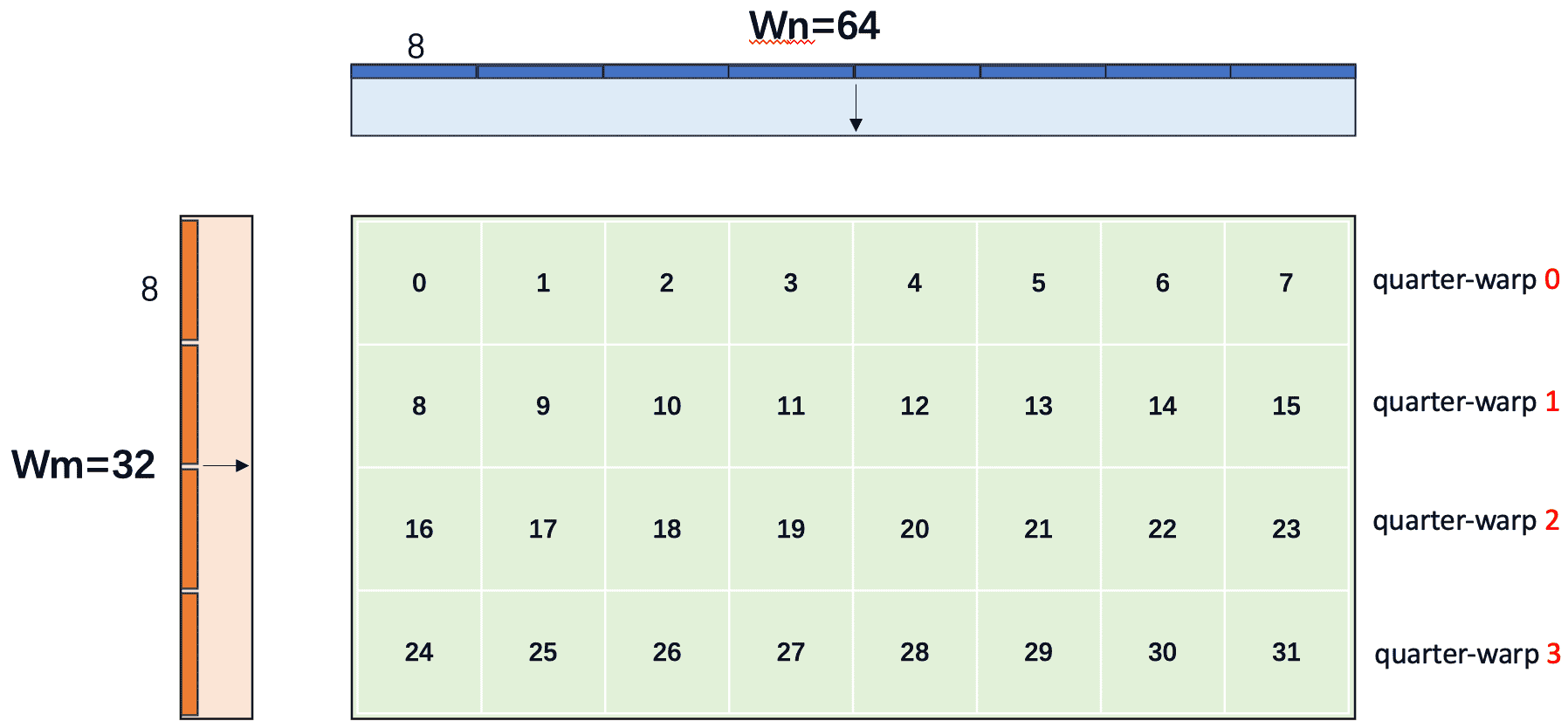
Reading tileA (transposed As[k][thread_row..thread_row+7]):
Each lane’s starting M coord is lane_row * TM = lane_row * 8. All 8 lanes in the quarter-warp share lane_row (all 0) → all 8 hit the exact same float4 address.
One unique float4 in the quarter-warp → 8-way broadcast → 1 transaction inside the quarter-warp.
Cross–quarter-warp uniform-access merge (§8.2):
- Condition A:
lane iandlane i⊕1— xor 1 flips bit 0 only, which sits onlane_col;lane_rowunchanged → same A address → condition A holds globally ✅
→ LDS.128 register packing drops requests from 4 to 2 → 2 transactions for the whole warp.
📎 Matches NVIDIA forum hardware notes: on CC 7.0+, uniform access can cut LDS.128 requests/instruction from 4 to 2 (Greg @NV, 2018).
Reading tileB (Bs[k][thread_col..thread_col+7]):
Each lane starts at N = lane_col * TN = lane_col * 8. The 8 lanes have distinct lane_col = 0..7:
| lane | Start N | B elements | Banks |
|---|---|---|---|
| 0 | 0 | B[0:4] | 0~3 (layer 0) |
| 1 | 8 | B[8:12] | 8~11 (layer 0) |
| 2 | 16 | B[16:20] | 16~19 (layer 0) |
| 3 | 24 | B[24:28] | 24~27 (layer 0) |
| 4 | 32 | B[32:36] | 0~3 (layer 1) |
| 5 | 40 | B[40:44] | 8~11 (layer 1) |
| 6 | 48 | B[48:52] | 16~19 (layer 1) |
| 7 | 56 | B[56:60] | 24~27 (layer 1) |
8 unique float4s, no broadcast. Worse: adjacent lanes are 8 floats apart (32 bytes = 8 banks); lane 0 starts at bank 0, lane 4 at bank 0 of the next layer ( floats = 1 bank layer) → 2-way bank conflict.
→ Each quarter-warp splits into 2 transactions → 8 transactions for the whole warp.
Summary:
| tile | Unique float4s in QW | Broadcast / conflict | Warp transactions |
|---|---|---|---|
| tileA | 1 | 8-way broadcast + condition A halving | 2 |
| tileB | 8 | 2-way bank conflict, no halving | 8 |
| Total | 10 |
📌 Observation: Under row-major layout, tileA enjoys perfect broadcast + uniform-access halving (only 2 transactions), but tileB’s N stride causes 2-way conflict and fails the halving conditions — overall 10 is still worse than column-major (6 transactions). That one side strong, one side weak asymmetry is what §8.5 option three (Z-order thread map) removes — a quarter-warp so xor-1 / xor-2 lane pairs share the same row on tileA and the same col on tileB, merging transactions on both sides without new conflicts.
8.5 Fixes
Option 1: Padding (tileA transposed)
Add an extra column in the shared declaration:
__shared__ float As[BK][BM + 4]; // shift bank mapping
Downside: breaks float4 alignment, so vectorized reads may fail.
Option 2: XOR swizzle (tileA transposed)
XOR remaps store addresses so conflicting accesses land in different banks:
// Swizzle on write
As[k][row ^ (k * 4)] = value;

// Undo with the same rule on read
float val = As[k][target_row ^ (k * 4)];
Upside: no extra space, keeps float4 alignment.
Option 3: Split the compute region into sub-blocks
Another approach keeps warp shape and changes each thread’s compute layout. Instead of one contiguous , split into four sub-blocks scattered in tileC.
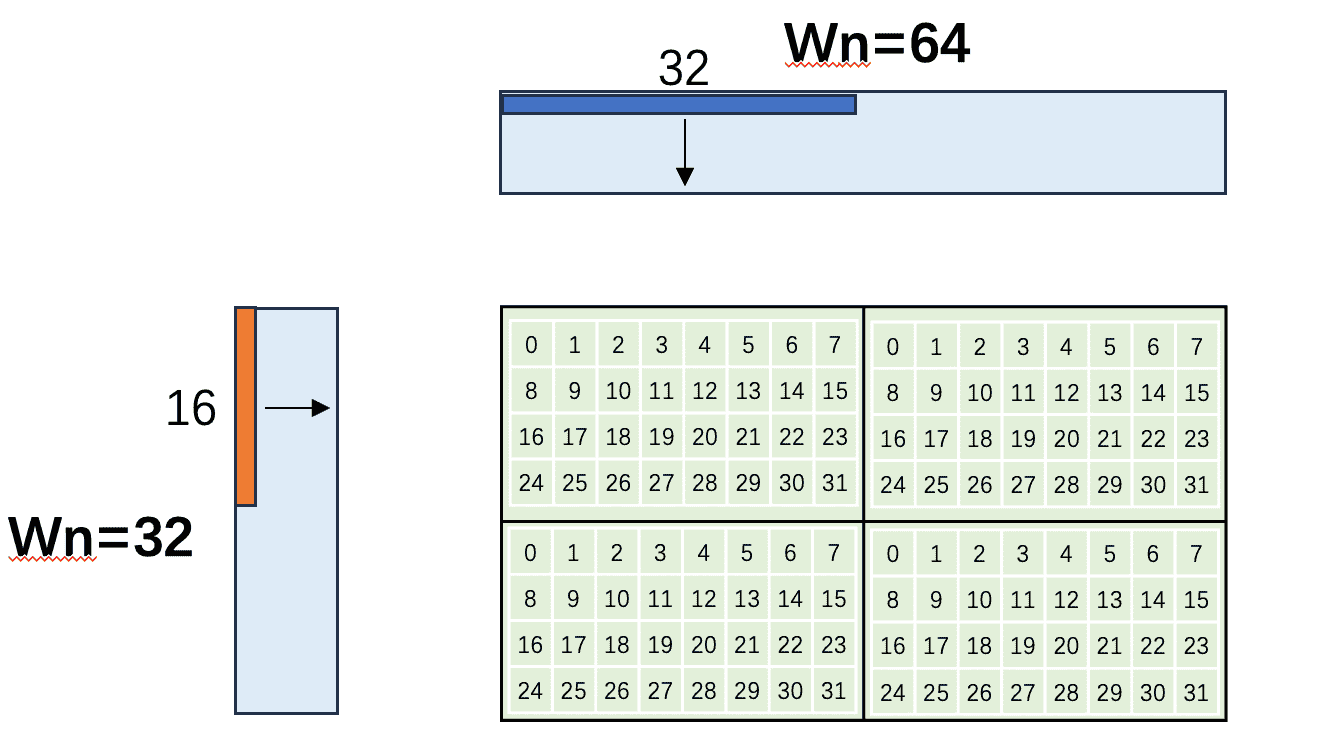
Core idea: when each thread reads float4, the 8 threads in a quarter-warp cover one full bank layer (32 consecutive floats = 8 × float4) with no cross-layer conflict. The split makes quarter-warp reads pack one bank layer contiguously instead of jumping layers.
Benefit: no change to thread–warp mapping, only local C layout. Cost: write-back to global is non-contiguous (scatter write).
QW’s 8 lanes share one row (lane_row=0) and fill 8 columns in N.
Reading tileA (transposed As[k][row*4 .. row*4+3]):
Each lane starts at M = lane_row * 4. All 8 QW lanes share lane_row (0) → same float4 address, 8-way broadcast.
Cross-QW merge:
- Condition A:
lane iandlane i⊕1(xor 1 flips bit 0 → onlylane_colchanges,lane_rowsame) → same A address → condition A holds ✅
→ 4 QW requests merge to 2 → 2 transactions for tileA across the warp.
Reading tileB (Bs[k][col*4 .. col*4+3]):
Each lane starts at N = lane_col * 4 (not baseline lane_col * 8). Starts and banks for the 8 QW lanes:
| lane | Start N offset | Elements | Banks |
|---|---|---|---|
| 0 | 0 | B[0:4] | 0~3 (layer 0) |
| 1 | 4 | B[4:8] | 4~7 (layer 0) |
| 2 | 8 | B[8:12] | 8~11 (layer 0) |
| 3 | 12 | B[12:16] | 12~15 (layer 0) |
| 4 | 16 | B[16:20] | 16~19 (layer 0) |
| 5 | 20 | B[20:24] | 20~23 (layer 0) |
| 6 | 24 | B[24:28] | 24~27 (layer 0) |
| 7 | 28 | B[28:32] | 28~31 (layer 0) |
Eight float4 addresses pack banks 0~31 of layer 0 — different banks, no conflict.
Versus baseline (lane_col * 8 spacing): baseline puts lane 0 and lane 4 32 floats = 1 bank layer apart → same bank, different address → 2-way conflict. Option four shrinks spacing from 8 to 4 so the 8 QW lanes fill one layer without spilling into the next.
Cross-QW merge check:
- Condition A:
lane iandlane i⊕1(lane_coldiffers by 1) → B starts differ by 4 → different addresses → fails ❌ - Condition B:
lane iandlane i⊕2(lane_coldiffers by 2) → B starts differ by 8 → different addresses → fails ❌
No cross-QW merge → 1 transaction per QW → 4 transactions for tileB across the warp.
Per-sub-block p-Loop transaction summary:
| tile | Conflict in QW | Cross-QW merge | Warp transactions |
|---|---|---|---|
| tileA | None (8-way broadcast) | Condition A | 2 |
| tileB | None (fills one bank layer) | No merge | 4 |
| Total | 6 |
Option 4: Z-order thread mapping
On top of option 3, reshape the quarter-warp from default (row-major) to Z-order so both tileA and tileB reads broadcast, cutting memory transactions from 10 to 4.
int lane_id = threadIdx.x % 32;
int lane_row = lane_id % 2 + (lane_id / 16) * 2;    // 4 rows
int lane_col = (lane_id % 16) / 2;                  // 8 cols
Expanding that map, the 32 lanes sit on a grid as follows:
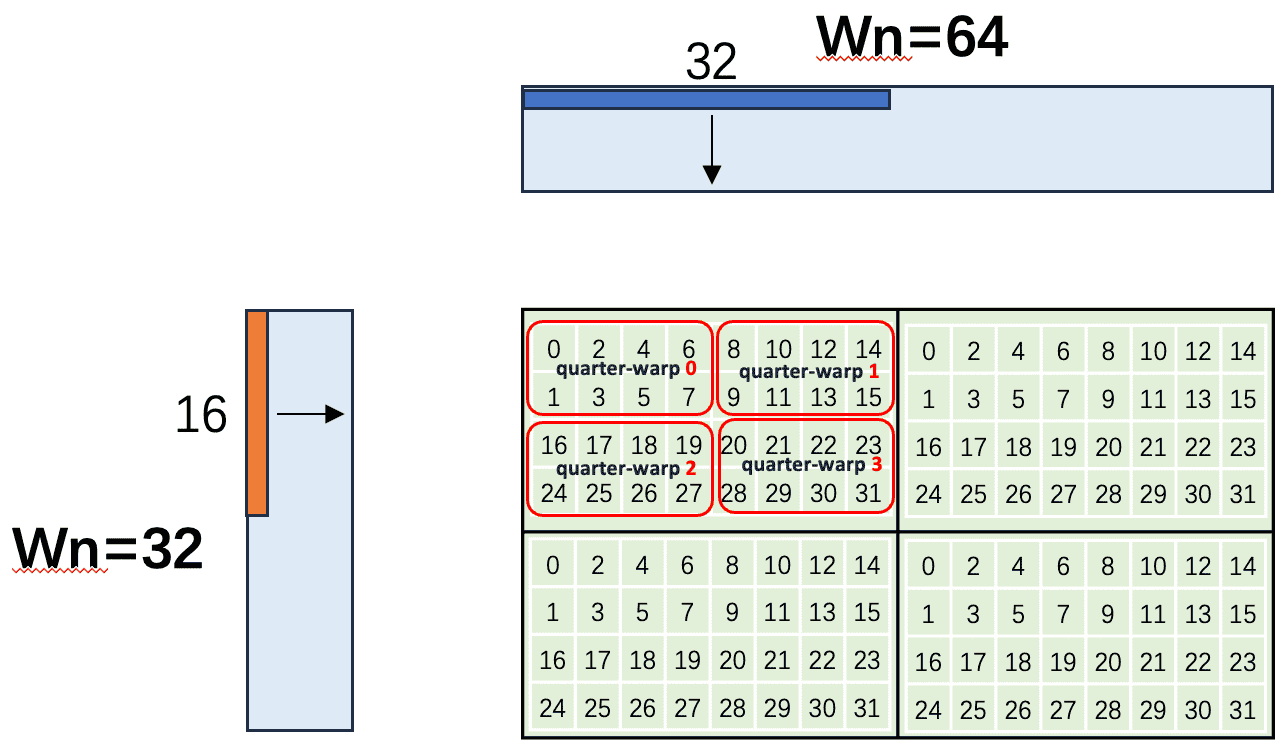
Each quarter-warp is 2 rows × 4 cols. Core idea: 8 QW lanes cover only 2 distinct lane_row and 4 distinct lane_col values, so tileA and tileB both broadcast inside the QW; xor 1 and xor 2 keep lane_col / lane_row unchanged respectively — exactly conditions A and B for cross-QW merge.
Reading tileA (transposed As[k][row*4 .. row*4+3]):
Only 2 distinct A addresses in the QW, each shared by 4 lanes (4-way broadcast); the two addresses hit different banks (0~3 vs 4~7) → no bank conflict.
Cross-QW merge:
- Condition B:
lane iandlane i⊕2(xor 2 flips bit 1 → onlylane_colchanges,lane_rowsame) → same A address → condition B holds ✅
→ 4 QW requests merge to 2 → 2 transactions for tileA across the warp.
Reading tileB (Bs[k][col*4 .. col*4+3]):
Each lane starts at N = lane_col * 4. QW0 starts and banks:
| lane | (row, col) | Start N offset | Banks |
|---|---|---|---|
| 0 | (0, 0) | 0 | 0~3 (layer 0) |
| 1 | (1, 0) | 0 | 0~3 (layer 0) |
| 2 | (0, 1) | 4 | 4~7 (layer 0) |
| 3 | (1, 1) | 4 | 4~7 (layer 0) |
| 4 | (0, 2) | 8 | 8~11 (layer 0) |
| 5 | (1, 2) | 8 | 8~11 (layer 0) |
| 6 | (0, 3) | 12 | 12~15 (layer 0) |
| 7 | (1, 3) | 12 | 12~15 (layer 0) |
Only 4 distinct B addresses in the QW, each shared by 2 lanes (2-way broadcast); four groups pack banks 0~15 of layer 0 → no bank conflict.
Cross-QW merge:
- Condition A:
lane iandlane i⊕1(xor 1 flips bit 0 → onlylane_rowchanges,lane_colsame) → same B address → condition A holds ✅
→ 4 QW requests merge to 2 → 2 transactions for tileB across the warp.
Per-sub-block p-Loop transaction summary:
| tile | Conflict in QW | Cross-QW merge | Warp transactions |
|---|---|---|---|
| tileA | None (4-way broadcast) | Condition B | 2 |
| tileB | None (2-way broadcast) | Condition A | 2 |
| Total | 4 |
Versus default (tileA 2 + tileB 8 = 10 transactions), Z-order (2 + 2 = 4) cuts memory transactions by 60%.
9. Double buffering and pipelining
9.1 Hiding global-memory latency
In the earlier kernels, every K-loop step waits for Global → Shared to finish before compute. Global latency is 300–500 cycles; compute units sit idle the whole time.
Double buffering is like ping-pong: two shared-memory buffers — compute from Buffer 0 while loading the next round into Buffer 1.
9.2 p-Loop double buffering (Shared → Register)
Each p-Loop step (inner K) needs: (1) read regA/regB from shared memory; (2) outer-product regA × regB. Serially, compute waits on the shared read (20–30 cycle latency).
With double-buffered registers, overlap read and compute:
float regA[2][Tm], regB[2][Tn];

#pragma unroll
for (int p = 0; p < BK + 1; p++) {
    // Compute phase: use data prefetched last step
    if (p > 0) {
        for (int i = 0; i < Tm; i++)
            for (int j = 0; j < Tn; j++)
                Ct[i][j] += regA[(p - 1) & 1][i] * regB[(p - 1) & 1][j];
    }

    // Prefetch phase: load this step into the other register set
    if (p < BK) {
        for (int i = 0; i < Tm / 4; i++)
            FLOAT4(regA[p & 1][i * 4]) = FLOAT4(As[p][...]);
        for (int j = 0; j < Tn / 4; j++)
            FLOAT4(regB[p & 1][j * 4]) = FLOAT4(Bs[p][...]);
    }
}
Compute (FFMA) and prefetch (LDS) hit different GPU execution units, so hardware can schedule them together and hide shared-memory latency.
9.3 K-Loop double buffering (Global → Shared)
Level 1: Global → Shared double buffer
__shared__ float As[2][BK][BM];  // two buffers
__shared__ float Bs[2][BK][BN];
Level 2: Shared → Register double buffer
float a_frag[2][TM];  // two register sets
float b_frag[2][TN];
9.4 Pipeline schedule
Instruction order is the key. Each main-loop iteration:
┌──────────────────────────────────────────────┐
│ 1. Issue LDG (load next-tile data into staging regs) │
│ 2. Run FFMA (compute with current buffer)            │
│ 3. Run STS (write staging regs into the other buffer)│
│ 4. __syncthreads() and flip buffer                   │
└──────────────────────────────────────────────┘
📌 Key point: Issue LDG before compute — LDG is async; after issue the thread keeps running FFMA, and by the time FFMA finishes the LDG data is usually ready. That hides 300+ cycles of global latency behind FFMA work.
9.5 Code skeleton
template <int BM, int BN, int BK, int TM, int TN>
__global__ void sgemm_double_buffer(const float* A, const float* B, float* C,
                                    int M, int N, int K) {
    __shared__ float As[2][BK][BM];
    __shared__ float Bs[2][BK][BN];

    float a_frag[2][TM], b_frag[2][TN];
    float c_frag[TM][TN] = {0.0f};
    float ldg_a[4], ldg_b[4];  // stage global loads

    int buf_idx = 0;

    // Prologue: load the first tile
    load_global_to_shared(A, B, As[0], Bs[0], /*tile_k=*/0);
    __syncthreads();

    // Prefetch first register set
    load_shared_to_reg(As[0], Bs[0], a_frag[0], b_frag[0], /*k=*/0);

    for (int tile_k = BK; tile_k < K + BK; tile_k += BK) {
        int next_buf = 1 - buf_idx;

        #pragma unroll
        for (int k = 0; k < BK; k++) {
            // Prefetch registers for the next k step
            if (k + 1 < BK) {
                load_shared_to_reg(As[buf_idx], Bs[buf_idx],
                                   a_frag[1 - k % 2], b_frag[1 - k % 2], k + 1);
            }

            // On the first k step, issue the next tile's global load
            if (k == 0 && tile_k < K) {
                issue_ldg(A, B, ldg_a, ldg_b, tile_k);
            }

            // TM×TN outer product
            outer_product(a_frag[k % 2], b_frag[k % 2], c_frag);
        }

        // Store LDG results into the next buffer
        if (tile_k < K) {
            store_reg_to_shared(ldg_a, ldg_b, As[next_buf], Bs[next_buf]);
        }
        __syncthreads();

        buf_idx = next_buf;
        load_shared_to_reg(As[buf_idx], Bs[buf_idx], a_frag[0], b_frag[0], 0);
    }

    // Write results
    store_c(c_frag, C);
}
9.6 Sync savings
A major win of double buffering: the main loop needs only one __syncthreads() (on buffer flip), not two — less sync overhead.
10. Ampere async-copy pipelines
10.1 cp.async
From SM80 (Ampere), NVIDIA added cp.async: async direct copy Global → Shared without a register staging hop:
cp.async.cg.shared.global [smem_ptr], [gmem_ptr], 16;
Benefits:
- Saves staging registers (~8 per thread)
- Deeper hardware pipeline, better latency hiding
- Supports multi-stage pipelines (3–4 stages)
10.2 Pipeline sync model
// Commit one async-copy group
cp.async.commit_group;

// Wait until at most N groups remain outstanding
cp.async.wait_group N;
__syncthreads();
By choosing wait_group parameter , you build a multi-stage pipeline: load stage while computing stage .
10.3 C++ API
CUDA 11+ adds a higher-level C++ abstraction:
#include <cuda/pipeline>
#include <cooperative_groups.h>

auto group = cooperative_groups::this_thread_block();
__shared__ cuda::pipeline_shared_state<cuda::thread_scope_block, 2> pipe_state;
auto pipe = cuda::make_pipeline(group, &pipe_state);

// Issue async copy
pipe.producer_acquire();
cuda::memcpy_async(group, smem_ptr, gmem_ptr, sizeof(float) * BK * BM, pipe);
pipe.producer_commit();

// Wait until data is ready
pipe.consumer_wait();
// ... compute ...
pipe.consumer_release();
10.4 CUTLASS multi-stage pipelines
On Ampere, CUTLASS defaults to 3–4 shared-memory buffer stages:
graph LR
    S0["Stage 0: computing"] --> S1["Stage 1: data ready"]
    S1 --> S2["Stage 2: loading"]
    S2 --> S3["Stage 3: issuing LDG"]
More stages hide longer latency but spend more shared memory. Three stages are the usual sweet spot.
10.5 Hopper (SM90): TMA and WGMMA
Hopper adds:
- TMA (Tensor Memory Accelerator): dedicated hardware for multi-dimensional tensor addressing and moves
- wgmma.async: warp-group async matrix-multiply that operates directly on shared memory
These further decouple data movement from compute — the direction GEMM optimization is heading.
11. SASS-level tuning and register scheduling
11.1 Register bank conflicts
The register file also has banks — 4 on all architectures, mapped as reg_id % 4 = bank_id.
If any two of an FFMA’s three source operands (, , ) land in the same bank, you get a register bank conflict and waste a cycle.
11.2 Register reuse cache
From Maxwell on, hardware has a Register Reuse Cache. When a SASS operand is marked .reuse, that value is kept in a small buffer so the next instruction can read from cache instead of the register file and avoid bank conflicts.
nvcc typically auto-marks reuse around 20%; hand-tuned SASS can reach 49%+, with a 5%–10% performance gap.
11.3 Register remapping
Carefully assign physical register numbers for c_frag elements so consecutive FFMA operands land in different banks:
// Goal: FFMA R_c, R_a, R_b, R_c
// Keep R_a, R_b, R_c on pairwise-different banks
// Strategy: assign register numbers in c_frag access order
That needs hand edits at SASS level with tools like CuAssembler or maxas.
11.4 Instruction interleaving
Interleave FFMA with LDS (shared-memory load) so FFMA compute latency hides LDS latency:
LDS R0, [R_addr]      // issue smem read, 20-30 cycle latency
FFMA R10, R4, R5, R10 // compute while waiting (need enough independent FFMAs)
FFMA R11, R4, R6, R11
FFMA R12, R4, R7, R12
FFMA R13, R4, R8, R13
...                    // ~20 independent FFMAs to fully hide LDS latency
FFMA R28, R2, R9, R28
// R0 is ready now
FFMA R14, R0, R5, R14 // use the LDS result
12. Parameter selection and tuning
12.1 Suggested parameters
| 📊 Param | ✅ Value | 📝 Notes |
|---|---|---|
| BM | 128 | Too small → weak intensity; too large → shared memory overflows |
| BN | 128 | Same |
| BK | 8 | Trades shared-memory use vs load-instruction count |
| TM | 8 | 8 rows per thread; registers can hold it |
| TN | 8 | 8 cols per thread |
| Block size | 256 | = (128/8) × (128/8) = 16×16 |
| Warp shape | 4×8 | Balances A/B access efficiency |
| Registers/thread | 120–128 | Control with __launch_bounds__ |
| Shared mem/block | 16–32 KB | Including double buffering |
12.2 Optimization stages and expected speed
| 📊 Stage | ⚡ vs cuBLAS | 📝 Main change |
|---|---|---|
| Naive | 6%–11% | Unoptimized baseline |
| Shared-memory tiling | 25%–40% | Data reuse |
| Thread tiling (register outer product) | 50%–65% | Fewer smem accesses |
| Vectorized load (float4) | 60%–75% | Fewer instructions |
| Bank-conflict removal | 70%–80% | Higher smem throughput |
| Warp tiling | 80%–87% | Better intra-warp access |
| Double buffering | 90%–97% | Hide latency |
| Hand-tuned SASS | 95%–99% | Register scheduling |
12.3 Tuning tools
- Nsight Compute: warp-stall reasons
Stall Long Scoreboard: global latency not hiddenStall MIO Throttle: too much shared-memory pressureStall Short Scoreboard: shared-memory latencyStall Barrier: waiting on sync
- cuobjdump / nvdisasm: inspect compiled SASS
- Occupancy Calculator: resource use vs occupancy
12.4 Coding-style traps that kill performance
Seemingly equivalent code can differ wildly at SASS. In reference kernels, style-only fixes can lift ~60% → ~93% of cuBLAS:
Bitwise ops instead of div/mod
Integer divide and mod compile to long instruction sequences on GPU (especially when the divisor is not a power of two). Bit ops free many instruction slots:
// ❌ Slow: compiler emits IMAD + SHR + ... sequences
int row = threadIdx.x / BN_TILE;
int col = threadIdx.x % BN_TILE;

// ✅ Fast: single instruction when BN_TILE is a power of two
int row = threadIdx.x >> 3;  // BN_TILE = 8
int col = threadIdx.x & 7;
#pragma unroll traps
The compiler only unrolls when trip count is known at compile time. If the loop start comes from a runtime value, nvcc often cannot prove a constant trip count and #pragma unroll silently does nothing:
// ❌ Will not unroll: start is computed at runtime
int start = threadIdx.x * TM;
#pragma unroll
for (int i = start; i < start + TM; i++) { ... }

// ✅ Unrolls: loop variable starts at 0
#pragma unroll
for (int i = 0; i < TM; i++) {
    int idx = threadIdx.x * TM + i;
    ...
}
Eliminate trivial loops
When the inner loop runs once (e.g. BK/float4_size = 8/4 = 2 or = 1), hand-unrolling removes loop overhead and possible spills:
// ❌ Loop runs once, but the compiler may keep the loop structure
for (int k = 0; k < BK / 4; k++) {
    tileA[...] = ldg_ptr[k];
}

// ✅ Fully unrolled
tileA[...] = ldg_ptr[0];  // BK=8, float4 load, only 2 loads needed
tileA[...] = ldg_ptr[1];
Template parameters for constant folding
Pass tile sizes as template parameters so the compiler folds every dependent value at compile time and drops runtime math:
template <int BM, int BN, int BK, int TM, int TN>
__global__ void sgemm_kernel(float* A, float* B, float* C, int M, int N, int K) {
    // BM/TM, BN/TN etc. evaluated at compile time
    constexpr int THREAD_X = BN / TN;
    constexpr int THREAD_Y = BM / TM;
    ...
}
📌 Key point: These style fixes free instruction-pipeline slots from non-compute work (integer math, branches, address calc) so more slots go to FFMA.
12.5 Common pitfalls
❌ Don’t:
- Chase high occupancy: GEMM rides ILP, not TLP; 25% occupancy is usually enough
- Use
#pragma unrollwhen the loop variable does not start at 0 — the compiler will not unroll - Launch fewer blocks than SMs — GPU underutilized
- Ignore the K-not-divisible-by-BK boundary case
✅ Do:
- Prefer bitwise over div/mod:
x / 8→x >> 3,x % 8→x & 7 - Cap registers with
-maxrregcount=128or__launch_bounds__(256, 2) - Profile with Nsight Compute first, then optimize the real bottleneck
- Auto-tune across matrix shapes
📝 Summary
CUDA GEMM optimization is full-stack work from the application down to microarchitecture. The playbook is:
- Raise arithmetic intensity: tiling (Block → Thread → Warp) lifts reuse level by level
- Hide memory latency: double buffering / pipelines overlap compute with data movement
- Max out bandwidth: vectorized loads, kill bank conflicts, use broadcast
- Schedule instructions carefully: register assignment, interleaving, reuse cache
Each layer is a race between “moving data” and “computing” — you keep giving compute more of the clock. Once you have the playbook, you can write a fast GEMM kernel and carry the same thinking to other memory-heavy CUDA ops.
🎯 Self-check list
- Derive how GEMM tiling lifts arithmetic intensity from 0.25 to 32 FLOPs/Byte
- Name the bottlenecks of naive, shared-memory tiling, and thread tiling
- Implement an SGEMM kernel with shared-memory tiling + thread tiling on your own
- Explain why outer product reuses shared memory better than inner product
- Sketch the LDG / FFMA / STS time overlap in a double-buffer pipeline
- Use Nsight Compute to tell Stall Long Scoreboard from MIO Throttle
- State when shared-memory bank conflicts happen and three ways to fix them
- Explain why a 4×8 warp shape beats 1×32
- Compute register use and occupancy for given TM/TN/BM/BN
- Explain what cp.async buys over classic LDG+STS
📚 References
- CUTLASS: CUDA Templates for Linear Algebra Subroutines
- Optimizing-SGEMM-on-NVIDIA-Turing-GPUs (yzhaiustc)
- Hands-on-GEMM (AyakaGEMM)
- NVIDIA CUDA C++ Programming Guide - Shared Memory
- maxas - Open Source Maxwell Assembler
- How to Optimize a CUDA Matmul Kernel for cuBLAS-like Performance (Simon Boehm)
- CUDA Matrix Multiply Optimization - Lei Mao’s Blog
- CuAssembler - CUDA Assembler
- NVIDIA Nsight Compute Documentation
- Volta Architecture and Performance Optimization (GTC 2018)
- NVIDIA Forum: How to understand the bank conflict of shared memory — Robert Crovella on LDS.128’s 4-transaction split rule
- NVIDIA Forum: Unexpected shared memory bank conflict — Greg @NV on how SM 7.0+ uniform access cuts LDS.128 requests from 4 to 2
- Official CUTLASS: Fast Linear Algebra in CUDA C++
- NervanaSystems SGEMM optimization