2.2 Memory access optimization
Memory access efficiency is the biggest lever for CUDA Kernel performance
Memory access efficiency is the biggest lever for CUDA Kernel performance. This article digs into coalesced access (how it works and how to judge it), shared-memory Bank Conflicts and the Padding fix, and practical tricks for vectorized loads (float4/int4) that raise bandwidth use.
📑 Table of contents
- 1. Why memory access is the bottleneck
- 2. Global memory and coalesced access
- 3. Shared memory and Bank Conflict
- 4. Vectorized loads
- 5. Memory access optimization in practice
- 6. Advanced tips and tools
- Summary
- Self-check list
- References
1. Why memory access is the bottleneck
A GPU is like a huge factory — thousands of machines (compute cores) run at once on the shop floor, but the raw-material warehouse (device memory) has only one haul route (the memory bus). No matter how fast the machines are, if that route is jammed the whole line waits.
Quick arithmetic: an A100 peaks at 312 TFLOPS (FP16 Tensor Core), while HBM2e bandwidth is about 2 TB/s. For a simple vector add c[i] = a[i] + b[i]:
That is only 0.05% of peak. So tuning memory access patterns often lifts performance more than tuning the arithmetic.
1.1 Quick Roofline refresher
The Roofline model splits Kernels into two kinds:
- Memory-Bound: limited by bandwidth; optimize by cutting memory traffic and raising access efficiency
- Compute-Bound: limited by compute; optimize by raising compute parallelism
Most Kernels (especially elementwise, reduction, matrix transpose, and similar) are Memory-Bound. For them, coalesced access and efficient memory use are the performance key.
2. Global memory and coalesced access
2.1 How coalesced access works
Global memory access is merged into transactions at Warp granularity. When 32 threads in a Warp issue memory reads or writes together, hardware tries to merge those requests into as few memory transactions as possible.
Each memory transaction is 32 Bytes (one cache line sector). An L1 cache line is 128 Bytes, made of 4 × 32B sectors.
💡 Tip: The core rule for coalesced access is simple — consecutive threads in a Warp should touch consecutive memory addresses.
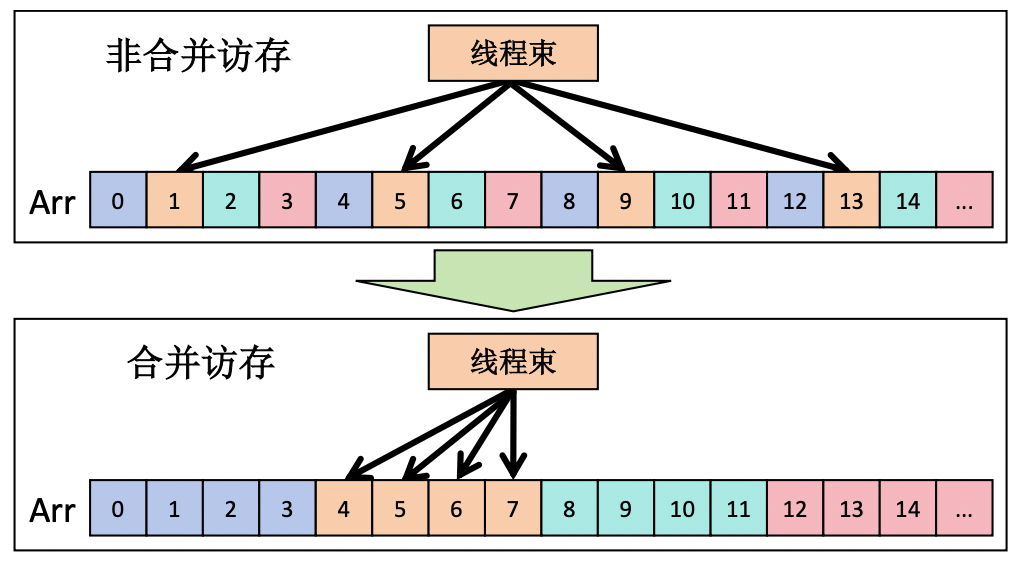
2.2 Coalesced vs non-coalesced performance
// ✅ Coalesced: consecutive threads touch consecutive addresses
// 32 threads in 1 Warp touch 128B contiguous, landing in 1 cache line
__global__ void coalesced_read(float* data, float* out, int N) {
    int tid = threadIdx.x + blockIdx.x * blockDim.x;
    if (tid < N) {
        out[tid] = data[tid];  // data[0], data[1], ..., data[31] contiguous
    }
}

// ❌ Non-coalesced (strided): consecutive threads touch spaced addresses
// With stride=32, addresses differ by 128B each → 32 transactions
__global__ void strided_read(float* data, float* out, int N, int stride) {
    int tid = threadIdx.x + blockIdx.x * blockDim.x;
    if (tid < N) {
        out[tid] = data[tid * stride];  // data[0], data[32], data[64], ...
    }
}
Performance comparison (A100, reading 1GB):
| 📊 Access pattern | Memory transactions | Effective bandwidth use | Relative time |
|---|---|---|---|
| Contiguous + aligned (stride=1) | 1x | ~95% | 1x |
| stride=2 | 2x | ~50% | 2x |
| stride=4 | 4x | ~25% | 4x |
| stride=32 | 32x | ~3% | 32x |
| Fully random | 32x | ~3% | 32x |
2.3 Alignment requirements
Continuity is not enough; alignment matters too:
// ✅ Aligned: base address is a multiple of 128B
float* aligned_ptr = data;  // cudaMalloc guarantees 256B alignment
out[tid] = aligned_ptr[tid];

// ⚠️ Offset access: base is misaligned, may add an extra transaction
out[tid] = data[tid + 1];  // base offset by 4B, no longer 128B-aligned
The good news: memory from cudaMalloc is always 256-byte aligned, so contiguous access from the start usually has no alignment issue. Watch out for manual pointer offsets.
2.4 Array of Structures vs Structure of Arrays
The classic AoS vs SoA question:
// ❌ AoS (Array of Structures): bad for coalescing
struct Particle {
    float x, y, z, w;
};
Particle particles[N];
// Reading all x: particles[0].x, particles[1].x, ...
// Address jumps: 0, 16, 32, 48, ... (stride=4)

// ✅ SoA (Structure of Arrays): good for coalescing
struct ParticlesSoA {
    float x[N], y[N], z[N], w[N];
};
ParticlesSoA particles;
// Reading all x: particles.x[0], particles.x[1], ...
// Contiguous: 0, 4, 8, 12, ... (stride=1)
📌 Key point: In GPU programming, SoA almost always beats AoS, because Warp-parallel execution naturally wants consecutive threads on consecutive fields.
2.5 Row vs column access on 2D arrays
// 2D array is row-major; element[row][col] lives at row*cols+col
// ✅ Row-wise traversal: consecutive threads touch consecutive columns in one row
int col = threadIdx.x + blockIdx.x * blockDim.x;
int row = blockIdx.y;
float val = matrix[row * cols + col];  // coalesced

// ❌ Column-wise traversal: consecutive threads touch consecutive rows in one column
int row2 = threadIdx.x + blockIdx.x * blockDim.x;
int col2 = blockIdx.y;
float val2 = matrix[row2 * cols + col2];  // stride = cols, terrible
3. Shared memory and Bank Conflict
3.1 Shared memory Bank layout
Shared memory is split into 32 Banks (same as Warp size), each 4 Bytes (32 bits) wide. Consecutive 4-byte words land in consecutive Banks:
Addresses 0~3:   Bank 0
Addresses 4~7:   Bank 1
Addresses 8~11:  Bank 2
...
Addresses 124~127: Bank 31
Addresses 128~131: Bank 0  (wraps)
...
Each clock cycle, each Bank can serve one read or write. If multiple threads in the same Warp hit different addresses in the same Bank, those accesses serialize — that is a Bank Conflict.
3.2 Bank Conflict types and cost
| 📊 Conflict type | Meaning | Performance impact |
|---|---|---|
| No Conflict | 32 threads hit 32 different Banks | Done in 1 cycle |
| 2-way Conflict | 2 threads hit the same Bank | 2 cycles (serialized) |
| N-way Conflict | N threads hit the same Bank | N cycles |
| Broadcast | Multiple threads hit the same address in one Bank | 1 cycle (free) |
⚠️ Note: Broadcast is special — if many threads read the exact same address, hardware broadcasts that value to all requesters and it is not a conflict. Only “same Bank, different addresses” conflicts.
3.3 Classic conflict case: matrix transpose
// Naive matrix transpose
__shared__ float tile[32][32];

// On write: consecutive threads write different columns of one row → no conflict
tile[threadIdx.y][threadIdx.x] = input[gy * N + gx];

// On read: consecutive threads read different rows of one column
output[gx * N + gy] = tile[threadIdx.x][threadIdx.y];
// threadIdx.x=0 → tile[0][ty], address= (0*32+ty)*4 = ty*4 → Bank = ty%32
// threadIdx.x=1 → tile[1][ty], address= (1*32+ty)*4 → Bank = (32+ty)%32 = ty%32
// threadIdx.x=2 → tile[2][ty], address= (2*32+ty)*4 → Bank = (64+ty)%32 = ty%32
// Every thread hits the same Bank (= ty%32) → 32-way Bank Conflict!
3.4 Fix one: Padding
Add one extra column in the shared-memory declaration to break the multiple-of-32 mapping:
// ✅ Add 1 column of Padding
__shared__ float tile[32][32 + 1];  // 33 columns

// Originally tile[row][col] address = (row * 32 + col) * 4
// Now tile[row][col] address = (row * 33 + col) * 4
// Bank = (row * 33 + col) % 32

// Reading tile[threadIdx.x][ty]:
// threadIdx.x=0 → Bank = (0*33+ty)%32 = ty%32
// threadIdx.x=1 → Bank = (1*33+ty)%32 = (33+ty)%32 = (1+ty)%32
// threadIdx.x=2 → Bank = (2*33+ty)%32 = (66+ty)%32 = (2+ty)%32
// Each thread hits a different Bank → no conflict!
Padding wastes 4 Bytes of shared memory per row, but the speedup usually dwarfs that cost.
3.5 Fix two: Swizzle (advanced)
For some access patterns, you can remapping addresses (Swizzle) to avoid conflicts:
// Swizzle idea: scramble Bank distribution with XOR on the linear index
__device__ int swizzle_index(int row, int col) {
    return row * 32 + (col ^ row);  // XOR remap
}

// Write
tile[row][col ^ row] = input_val;
// Read
float val = tile[col][row ^ col];
Swizzle wastes no extra space, but index math gets harder. High-performance GEMM (e.g. CUTLASS) uses it widely.
3.6 How to detect Bank Conflicts
Use Nsight Compute and watch shared-memory metrics:
l1tex__data_bank_conflicts_pipe_lsu_mem_shared_op_ld  # load conflicts
l1tex__data_bank_conflicts_pipe_lsu_mem_shared_op_st  # store conflicts
If either counter is non-zero, you have Bank Conflicts and should inspect the shared-memory access pattern.
4. Vectorized loads
4.1 What vectorized loads are
A vectorized load reads several contiguous elements with one instruction (e.g. float4 reads 4 floats, 16 Bytes). Benefits:
- Fewer instructions: 4 ×
LDG.32→ 1 ×LDG.128 - Better bandwidth use: each transaction carries more useful data
- Less scheduling overhead: fewer memory instructions in the queue
4.2 Common vector types
| 📊 Type | Size | Equivalent |
|---|---|---|
float2 | 8 Bytes | 2 floats |
float4 | 16 Bytes | 4 floats |
int4 | 16 Bytes | 4 ints |
double2 | 16 Bytes | 2 doubles |
💡 Tip: One GPU cache line is 128 Bytes. A Warp of 32 threads each loading one float4 (16B) = 512B needs 4 cache lines. Each loading one float (4B) = 128B needs 1 cache line. Cache-line requests go up, but each load instruction moves 4× the data, so total instruction count drops 75%.
4.3 Basic usage
// Scalar version: each thread loads 1 float
__global__ void scalar_copy(float* dst, float* src, int N) {
    int tid = threadIdx.x + blockIdx.x * blockDim.x;
    if (tid < N) {
        dst[tid] = src[tid];
    }
}

// Vectorized version: each thread loads 4 floats
__global__ void vectorized_copy(float* dst, float* src, int N) {
    int tid = threadIdx.x + blockIdx.x * blockDim.x;
    int idx = tid * 4;  // each thread owns 4 elements

    if (idx + 3 < N) {
        // Cast float* to float4*; one instruction reads 16B
        float4 val = reinterpret_cast<float4*>(src)[tid];
        reinterpret_cast<float4*>(dst)[tid] = val;
    }
}
4.4 Alignment requirements
Vectorized loads need strict alignment:
// float4 requires 16B alignment
// Addresses from cudaMalloc are 256B-aligned → OK

// Offsets need special handling
float* base = ...; // 256B-aligned
float* offset_ptr = base + 3;  // offset 12B, not 16B-aligned

// ✅ Safe approach: scalar-handle the unaligned head, then vectorize the body
__global__ void safe_vectorized(float* data, int offset, int N) {
    // Handle unaligned head elements
    int align_offset = (4 - (offset % 4)) % 4;
    // ... scalar process the first align_offset elements

    // Vectorize the body
    float4* aligned_ptr = reinterpret_cast<float4*>(data + offset + align_offset);
    // ...
}
4.5 Practical pattern: vectorized reduction
__global__ void vectorized_sum(float* input, float* output, int N) {
    int tid = threadIdx.x + blockIdx.x * blockDim.x;
    int stride = blockDim.x * gridDim.x;

    float sum = 0.0f;

    // Each iteration handles 4 elements
    int vec_N = N / 4;
    float4* vec_input = reinterpret_cast<float4*>(input);

    for (int i = tid; i < vec_N; i += stride) {
        float4 val = vec_input[i];
        sum += val.x + val.y + val.z + val.w;
    }

    // Tail elements that do not fill a group of 4
    int tail_start = vec_N * 4;
    for (int i = tail_start + tid; i < N; i += stride) {
        sum += input[i];
    }

    // Then do a Block reduction...
    output[blockIdx.x] = sum;  // simplified; real code needs a reduction
}
4.6 When to use vectorized loads
| ✅ Good fit | ❌ Poor fit |
|---|---|
| Elementwise ops (add/sub/mul/div) | Complex index patterns (gather/scatter) |
| Large copies/initialization | Length not a multiple of 4 and no tail handling |
| Bandwidth-bound Kernels | Compute-bound Kernels (bottleneck is not memory) |
| Addresses can be kept aligned | Base address cannot be aligned |
5. Memory access optimization in practice
5.1 Case study: matrix transpose
Matrix transpose is the textbook memory-access case: no arithmetic, so performance is entirely about access efficiency.
Naive version:
__global__ void transpose_naive(float* out, float* in, int width, int height) {
    int col = threadIdx.x + blockIdx.x * blockDim.x;
    int row = threadIdx.y + blockIdx.y * blockDim.y;
    if (col < width && row < height) {
        out[col * height + row] = in[row * width + col];
        // Read: coalesced (consecutive threads hit consecutive columns)
        // Write: not coalesced (stride = height)
    }
}
Shared-memory optimized version:
// Each thread handles TILE_DIM / BLOCK_ROWS elements
#define TILE_DIM 32
#define BLOCK_ROWS 8

__global__ void transpose_shared(float* out, float* in, int width, int height) {
    __shared__ float tile[TILE_DIM][TILE_DIM + 1];  // +1 Padding kills Bank Conflict

    int x = blockIdx.x * TILE_DIM + threadIdx.x;
    int y = blockIdx.y * TILE_DIM + threadIdx.y;

    // Coalesced read: each warp reads contiguous elements
    for (int j = 0; j < TILE_DIM; j += BLOCK_ROWS) {
        if (x < width && (y + j) < height) {
            tile[threadIdx.y + j][threadIdx.x] = in[(y + j) * width + x];
        }
    }

    __syncthreads();

    // Coalesced write: after transpose, consecutive threads write consecutive addresses
    x = blockIdx.y * TILE_DIM + threadIdx.x;
    y = blockIdx.x * TILE_DIM + threadIdx.y;

    for (int j = 0; j < TILE_DIM; j += BLOCK_ROWS) {
        if (x < height && (y + j) < width) {
            out[(y + j) * height + x] = tile[threadIdx.x][threadIdx.y + j];
        }
    }
}

// Launch:
// dim3 block(TILE_DIM, BLOCK_ROWS);
// dim3 grid((width + TILE_DIM - 1) / TILE_DIM, (height + TILE_DIM - 1) / TILE_DIM);
Core idea: use shared memory as a staging area, turn a non-coalesced global write into a column read from shared memory (Padding removes Bank Conflicts), then write out coalesced.
5.2 Case study: memory optimization in reduction
// ❌ Naive reduction: interleaved access → Bank Conflict and poor bandwidth use
__global__ void reduce_interleaved(float* input, float* output, int N) {
    int tid = threadIdx.x;
    int idx = blockIdx.x * blockDim.x + tid;
    __shared__ float sdata[256];
    sdata[tid] = (idx < N) ? input[idx] : 0.0f;
    __syncthreads();

    for (int s = 1; s < blockDim.x; s *= 2) {
        if (tid % (2 * s) == 0) {
            sdata[tid] += sdata[tid + s];
        }
        __syncthreads();
    }
    if (tid == 0) output[blockIdx.x] = sdata[0];
}

// ✅ Optimized reduction: consecutive threads operate on consecutive addresses
__global__ void reduce_sequential(float* input, float* output, int N) {
    int tid = threadIdx.x;
    int idx = blockIdx.x * blockDim.x + tid;
    __shared__ float sdata[256];
    sdata[tid] = (idx < N) ? input[idx] : 0.0f;
    __syncthreads();

    for (int s = blockDim.x / 2; s > 0; s >>= 1) {
        if (tid < s) {
            sdata[tid] += sdata[tid + s];
        }
        __syncthreads();
    }
    if (tid == 0) output[blockIdx.x] = sdata[0];
}
6. Advanced tips and tools
6.1 Cache hints
CUDA lets you steer cache policy on memory access:
// __ldg() loads through the read-only data cache (texture cache)
// Good for read-only data; can avoid polluting L1
float val = __ldg(&input[tid]);

// PTX-level cache control (via inline asm or compiler flags)
// .ca (cache all levels) — default; cache in L1 and L2
// .cg (cache global) — cache only in L2, skip L1
// .cs (cache streaming) — mark as streaming data, lower priority
// .cv (cache volatile) — do not cache; always read from device memory
6.2 Memory access analysis tools
Key Nsight Compute metrics:
# Global memory efficiency
sm__sass_average_data_bytes_per_sector_mem_global_op_ld  # ideal 128B
l1tex__t_sectors_pipe_lsu_mem_global_op_ld  # actual transaction count

# Compute bandwidth utilization
gpu__compute_memory_throughput  # actual throughput
dram__bytes_read + dram__bytes_write  # actual bytes moved
6.3 Optimization decision flowchart
graph TD
    A["Profile Kernel performance"] --> B{"Memory-Bound?"}
    B -->|Yes| C["Check global memory access pattern"]
    B -->|No| D["Optimize compute logic"]
    C --> E{"Coalesced?"}
    E -->|No| F["Reshape layout / SoA"]
    E -->|Yes| G["Check shared memory"]
    G --> H{"Bank Conflict?"}
    H -->|Yes| I["Padding / Swizzle"]
    H -->|No| J["Try vectorized loads"]
    J --> K{"At bandwidth ceiling?"}
    K -->|Yes| L["Done"]
    K -->|No| M["Cut redundant access / raise reuse"]
📝 Summary
| Technique | Core idea | Payoff |
|---|---|---|
| Coalesced access | Consecutive threads, consecutive addresses; SoA over AoS | Up to 32× bandwidth gap |
| Aligned access | Base address aligned to 128B | Avoid extra transactions |
| Padding | Shared memory [N][N+1] breaks Bank period | Kill Bank Conflicts |
| Vectorized load | float4 / int4 reads 16B at once | ~75% fewer instructions |
| Cache hints | __ldg(), cache policy control | Less cache pollution |
| Data layout | AoS → SoA, row/column swap | Structural fix for coalescing |
🎯 Self-check list
- Can judge whether a given access pattern meets coalesced-access conditions
- Can compute how many 32B transactions a Warp needs for a global access
- Can rewrite an AoS layout into SoA for coalesced access
- Can explain shared-memory Bank addressing and why Bank Conflicts happen
- Can add Padding to fix 32-way Bank Conflict code
- Can use
float4correctly for vectorized load and store - Can handle alignment and tail elements in vectorized loads
- Can use shared memory to turn a non-coalesced global write into a coalesced write
- Can use Nsight Compute to spot memory-efficiency metrics
- Can apply a full memory-access optimization chain to a matrix-transpose Kernel
📚 References
- NVIDIA CUDA C++ Programming Guide - Memory Hierarchy
- NVIDIA CUDA C++ Best Practices Guide - Memory Optimizations
- An Efficient Matrix Transpose in CUDA C/C++ - NVIDIA Developer Blog
- How to Access Global Memory Efficiently in CUDA C/C++ Kernels - NVIDIA Developer Blog
- CUTLASS: CUDA Templates for Linear Algebra Subroutines - GitHub